Leonardo White Paper
“Stolen, Abused, and Misused”
The unfortunate reality of hotel content, and the rush to correct it
Research by: John Burns | Written by: David Sgroi
In early 2026, an executive from one of the travel industry’s leading revenue generating channels shared a LinkedIn post outlining the four phases of booking a vacation: inspiration, booking, the journey, and after the trip. Seventy-five percent of respondents agreed that the inspiration and booking phases are the most critical, as they are when travelers often make the decisions that shape their overall experience. At this stage, those make-or-break choices are driven by perceived value; balanced between the cost of the trip and the experience promised. The outcome will influence whether the memories they take home are positive or negative.
With what seems like the overnight emergence of AI, the travel industry will be forced to adapt to the constant advancements of technology, the ongoing mergers and acquisitions, strategic partnerships and more that have made the travel sector one of the most “interconnected” industries in the world.
On top of the constant changes to our industry, hotel brands have teams of content specialists, scouring the internet, playing both offense and defense to ensure their hotels’ “story” is accurate and up to date across hundreds of channels, all chasing revenue that takes away from highly preferred, direct booking that comes without a heavy commission. The reality of Direct vs. Indirect bookings is that achieving perfection will never happen, but when you add in bed banks, startups and channels that don’t play by the rules, you add in lost revenue in the form of customers who are misled, whether it is done with intention or not. When a Travel Channel is looking for the most “cost-effective” way to generate a booking, corners are cut, content is mismanaged and everyone loses. It is at this point that hotel chains lose a staggering amount of “control” over their content, and the hundreds of channels that consume this content build their business without understanding that saving a couple of dollars today may result in a nightmare for their business as well as the hotel brands that keep their lights on.
Let us return to the HEDNA (Hotel Electronic Distribution Networking Association) conference held in Portugal in September 2025. HEDNA brings together brands, channels, and technology partners from around the world for three days focused on distribution. During a lunch meeting with one of Leonardo’s brand partners, the conversation centered on two bed banks that had refused to adopt the brand’s required content standards and openly admitted to scraping images from the internet. At that point, Leonardo recognized it was time to confront the harsh reality of content misuse. In line with its agreement with the brand, Leonardo raised the issue immediately, and the brand acted quickly to bring the channels under contract with Leonardo, its trusted source of truth, within a week. That moment led to the commissioning of this paper, which addresses the elephant in the room: hotel content is often stolen, abused, and misused, and the industry must take back control of its investment before the problem gets worse.
Following weeks of preparation, Leonardo flew a well-known hospitality consultant to Toronto for a few days of extensive interviews with 20 of the industry’s leading brands and channels, with the intent of delivering an unbiased view of content management and the increase in content scores, revenue and guest satisfaction that are a direct result of letting Leonardo manage their digital front door.
What is Content?
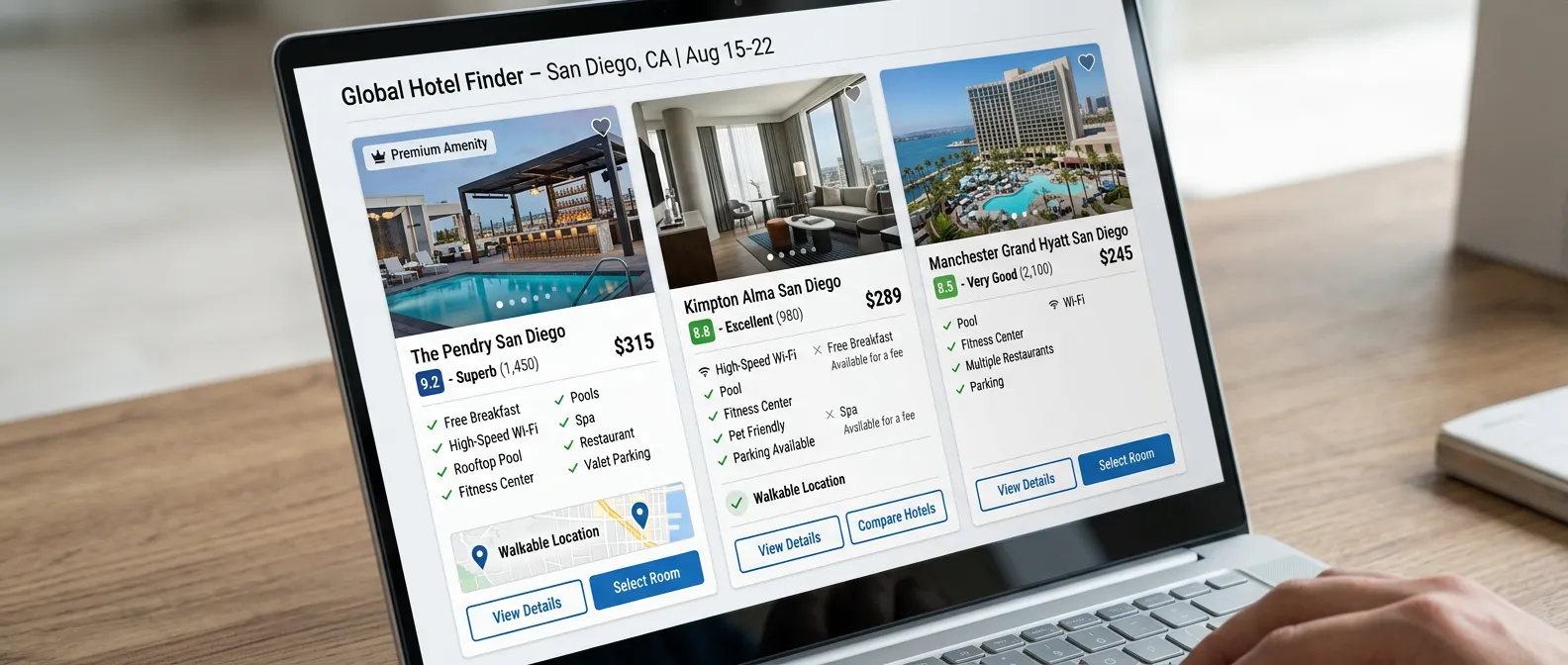
Hospitality has typically divided content into two categories: dynamic (rates) and static (images and textual). Leonardo has long been the industry leader in static content, traditionally defined as content that changes infrequently. However, COVID reshaped that definition entirely. Static content took on a new meaning as hotels frequently updated amenity availability, health and cleanliness policies, and local attraction information. These details are key factors in which hotel a guest will book and can eliminate a property from contention, if they live by the old definition of “Static Content”. In addition, any content used by parties, other than the brand, must be governed by the brand and maintained by content experts. Many companies claim they can manage content with the same precision Leonardo brings to its products, but the industry knows that few can deliver that standard. Hotel brands and travel channels may view rates as the top driver of bookings, but the real deciding factor is perceived value: how the rate compares to the experience offered through amenities, location, services, and brand reputation. Content is what communicates that value. Brand affiliation, facilities and amenities, bedding, availability of high-speed Internet access, of a gym, a pool, parking, or a free breakfast. These are all important selection criteria to make guests spend more per night. If there is one thing a brand knows, it is that ancillary revenue is the key to ensuring their hotels separate themselves from the pack and any misuse of this content can be detrimental to the overall success of the property and the brand itself.
Why Direct Content Matters
About 20 years ago, the battle between direct and indirect hotel bookings began. Since then, hospitality technology has advanced year after year, and tactics such as SEO and PPC have increased costs for both hotel brands and OTAs. To avoid driving up keyword prices, some brands even banned property-level vanity websites. Yet despite OTA commissions that can exceed 20%, consumer habits proved hard to change. As a result, many brands shifted their focus from fighting OTAs to presenting their properties consistently and in ways that align with each platform’s expectations to improve visibility; in other words, paying to play.
When accurate, high-quality content drives revenue and every hotel is competing to stand out, you need to ensure your property information is accurate, up to date, and aligned with each website’s requirements. The question is: do you manage this manually, site by site? That may have worked in the 90’s, but today the practical and affordable solution is reliable technology that integrates with your tech stack and automates the process.
The downside of content management is often the result of technology providers, OTAs, and bed banks focused on short-term profit with little regard for the impact on hotel brands. Common practices include scraping or stealing images, signing contracts that limit content use to specific rates while using it across an entire site, and uploading content once and leaving it unchanged for years. The seriousness of these disingenuous practices is clear, but many still ignore the consequences.
“That is why partnering with Leonardo is so important,” says the Vice President of Distribution, at a 500 property brand. “Knowing each channel, each individual recipient, who wants what, and in precisely what format, is complex, as is the timely and successful distribution of updates. This is what Leonardo is for.”
Getting Content Right and the Risks of Getting it Wrong
Leonardo has been the industry leader in content management and distribution for the better part of 30 years. Historically, Leonardo built the business by managing visual content for hotel brands and then delivering the content to the what is now around 500+ Channels. Leonardo has solely focused on content, with all its employees surfacing the same line: we are experts at content because that is our sole focus.
Paul Gillard, President at Leonardo explains: “Discipline is the weapon that destroys mediocrity. What makes us experts at our craft is the discipline to focus on just content.”
Delivering content well means having not only high-quality content everywhere travel shoppers are looking, but also ensuring the content is consistent with the story they are telling, everywhere else. As mentioned, many times already, many third-party channels try to cut costs by sourcing content from questionable intermediaries and bed banks, some moonlighting as the next best thing in Hospitality, yet selling products that are yet to be built, while relying on stolen content.
LET’S MAKE THIS LOUD AND CLEAR. THEY ARE NOT STEALING FROM LEONARDO OR OUR COMPETITION, THEY ARE STEALING FROM THE BRANDS THAT FUND THEIR BUSINESS, WITH NO REGARD FOR THE BRAND AND THEIR BUSINESS. AS FOR THEIR BUSINESS, THEY ARE MOST LIKELY SCRAPING CONTENT THAT WILL SOON BE OUT OF DATE, LACKS LIABILITY COVERAGE, AND IS MOST LIKELY LOW QUALITY. THIS PRACTICE IS HARMFUL TO THE CHAINS AND NEEDS TO BE STOPPED IMMEDIATELY .
With nearly 30 years of experience serving as the conduit for hotel content, Leonardo has seen, and continues to address a range of recurring industry challenges from the mishandling on content from certain companies, including:
- Incorrect content that leads to unhappy guests, which leads to loss of brand loyalty.
- Lawsuits dropped on brands for incorrect usage of content.
- Lawsuits dropped on channels for using images with no copyright.
- Loss of revenue, in the form of a booking or a refund due to inaccurate information.
- Channels that end up on the no fly list of certain brands, due to displaying content that they were not legally cleared to display.

These risks have actual costs. If a guest shows up at your hotel having booked a stay based on information on a third-party channel that is factually untrue, you will have to issue a potentially costly refund. For travel channels, relying on scraped data from “content pirates” can lead to legal issues if you are using content not pulled from their distributor of record.
So, what are the processes involved in assembling a trustworthy content strategy? What are the mechanics of structuring said content, so it will be readily usable by each channel? What must you have in place to successfully deliver that content to an extensive list of channels, who then place them in front of the prospective guest? Who makes this happen and who ensures data accuracy, data completeness, and data delivery?
Introducing LUCID Content Manager
Appealing and persuasive content is mission critical not only for hotels and hotel groups/brands, but also for travel channels. Leonardo sits in between the brand and the channel, acting not only as the technology, but also the liaison between the two. Let us spend the next couple minutes breaking down the process of what makes Leonardo THE gold standard of content distribution:
Step 1: The hotel or lodging brand is the first element in the content management/distribution process. They are the content source, the originator, and the owner of the content. To sell their property, one hotel manages between 25-100 photos, depending on the site and hundreds of textual content fields about their rooms, property amenities and more. The process of manually uploading, updating, and maintaining that information across an outrageous number of sites can lead to errors, legal issues, and lost revenue. Now imagine that across a brand that can have anywhere between 1-10,000 properties. One brand partner referred to it as “nightmare fuel and definitely the thing that kept them up at night, before signing up with Leonardo.”
Step 2: LUCID Content Manager receives content from the source and distributes in the form of a “single source of truth.” Content is uploaded, either manually or via API from the brand’s CRS. Once approved through the LUCID Workflow and Approval module, content is then normalized, including the tagging, categorizing, and resizing for easy ingestion. This creates both an internal system of record for the brand and automated updates to OTA’s, GDS’s, booking engines and more.
Step 3: The next destination for content may be Leonardo Media Library, a hospitality-specific digital asset manager that helps brands and hotels share content with internal teams and external partners, outside the channels covered in Step 2. Tailored to each brand, Media Library enables teams to store, share, and track real-time downloads of content loaded into LUCID. Media Library supports photos, text, PDFs, PowerPoint files, and more, making content securely available to press and media, marketing agencies, vendors, hotel sales and marketing teams, distribution teams, and other authorized users.
Hotel content preparation and distribution is a complex, multi-step process. It begins with data that both the hotel or brand and the sales channel agree is appropriate and necessary for display, including if it has been legally cleared for distribution. Leonardo Account Managers ensure that the quality meets brand standards. Following the content load, the next step is the channel-specific formatting of the content. Typically, a hotel wishes to distribute its content, and the frequent updates to it, to hundreds of electronic sales channels.
"Each channel has specific rules around content and which content will, and will not, be accepted; each channel has specific format requirements for the content it accepts and the Leonardo Team will work around the clock to ensure we are meeting the requirements of each channel, and giving our hotels the best shot at winning the booking.” says Kaydian Radway, Vice President of Operations. “Let us help you take back control of your content, while making honest channels succeed, and the channels that have stolen content, abused content, and misused content, tear the house down and build it from scratch.”
Repeatedly preparing individual content communications for each of the 500+ channels is an impossible manual task (and a complex automated task). To deal with this content communication challenge, hotels, and especially multi-property hotel brands, often contract with a company whose expertise is around all things content; One who is prepared to move with the brand in mind while they distribute channel-specific content messages, that contain their content updates, and to then communicate those messages promptly to the individual channels, in real time.
Each of these elements plays an indispensable role in a hotel’s online presentation and reservation.
Content Distribution Complexity
Distribution of digital content is inherently complex. Complicating factors include:
- The form of content being updated
- The rules of the travel channel ingesting the content
- Categories and formats within those content types
- Quality of the content generated by the hotel
Compounding this operational complexity is the need to enforce legal protections. These include infringement protection, which protects channel partners and onward distribution channels against copyright infringement, Image Compliance, and in the case of user generated content, ensuring that every image complies with Digital Millennium Copyright Act (DMCA) regulations. Overall, Leonardo has the responsibility of observing copyrights provided by hotel chains and maintaining copyright information provided by those chains.
Risk/Results of Content Delivery Errors or Shortcomings
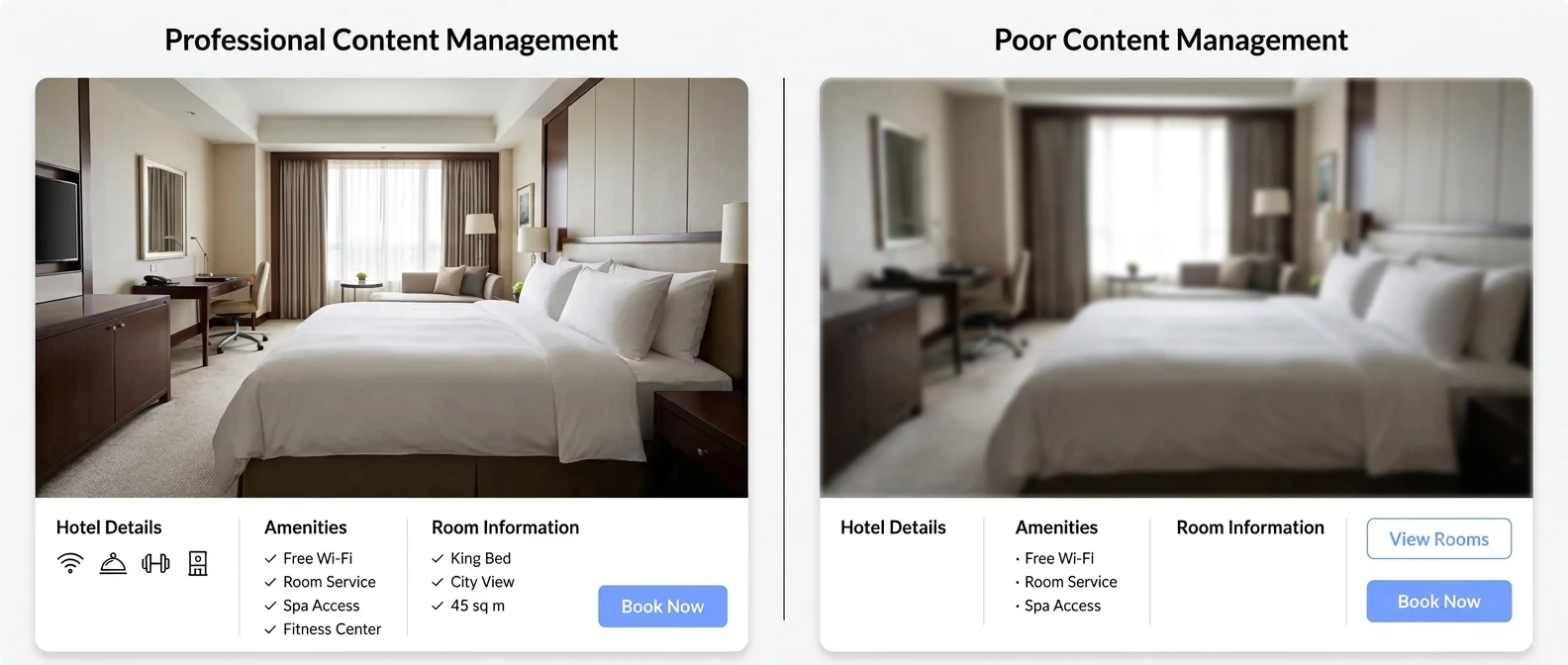
Content Management, including its many internal operations of content receipt, review, verification, adjustment, logging, recipient-specific formatting, delivery, and acceptance confirmation, are all crucial to the success of generating a booking.
A full-service, hotel-specific CMS maintains systems and monitoring processes to prevent, and when necessary, correct delivery errors. For hotels to maintain a similar level of content vigilance, implementing and maintaining this infrastructure would be a significant commitment and cost.
What are the risks? Some “less-than-full-service” content intermediaries distribute unauthorized materials, some obtained by screen scraping. They lack the ability to manage version-management capabilities and often store and distribute incomplete content. In some cases, they do not serve all expected distribution channels; in other cases, they sometimes distribute to unauthorized channels.
It is therefore essential for hotels to trust the content management experts.
In the event that your brand plans to work with a CMS, or you are a travel channel looking to build the foundation of your business, without having to tear it apart and start from scratch in a couple of years, Leonardo offers the ability to reach out and ensure you are doing the right thing.
“Some say buying a house is the most important purchase you will have as an adult, but pouring your life savings into a startup that you hope will lead to the “American Dream”, is right up there, in my opinion.” says David Sgroi, Vice President of Sales. “The worst thing you can do, is go down a path of building the house, only to tear it down to rebuild the foundation because you were misled or just didn’t know.” He finishes with, “reach out to the Leonardo team and let us assess your decision, walk you through our justification and if it doesn’t make business sense, get you connected to one API that serves up 185 brands and sub brands, with the click of your mouse. You can choose not to sign with Leonardo, but if you sign with us and our competitor, ICE Portal, you will have full coverage of the world’s leading hotel brands and never have to worry about losing content when you stop working with a company who has provided the content alongside their rate. Now, more than ever, ensuring that your business is set to autopilot and ready to embrace AI, should be priority number 1.”
Implementing LUCID Content Manager
Once a service agreement is in place, LUCID Content Manager creates the hotel brand in its database, as well as all properties that fall under that brand. Next, your brand can enter a wide variety, and considerable quantity, of content about the property, location and more.
Populating LUCID Content Manager can be done manually, through unlimited user profiles with custom approval processes. If your brand has reached the size where manual has become an impossible task, Leonardo can connect directly to the brand’s existing tech stack. LUCID Content Manager has fields for over 2,500 property attributes, including: policy descriptions, room type names and codes, restaurants and meeting rooms and experience descriptions. It can also store unlimited photos, videos, PowerPoints, Documents, Virtual tours and more.
Hotels partnering with Leonardo also work with a dedicated Implementation and Account Manager, which explains the quality standards and format requirements for each type of hotel data. They will carefully explain the process for submitting photos, including assignment of tags and effective captions to each one and ensure you are on the path to success.
As it is received, the content is then put through an extensive process that normalizes the descriptive content, tags images, removes duplicates, and stores copyright data. Additionally, room type codes can be associated with relevant imagery and paired with their room type descriptions.
Content Manager also prompts best practices in content preparation to ensure the hotel has the best chance of converting travel shoppers into confirmed guests.
This normalized, categorized content, both textual and visual, is then ready for distribution to third-party vendors. Leonardo has direct connectivity to an extensive network of online sales channels such as the Global Distribution Systems (GDS), including, Amadeus, Sabre, and Travelport (Galileo and Worldspan), as well as major online travel agents (e.g., Expedia, Booking.com, Trip.com, and more).
LUCID is also equipped with the ability to create custom integrations with new channels, either via push (sending content out via XML) or pull (connectivity via API), allowing channels to access the largest database of hotel content in the industry.
Additional Modules for Effective Content Strategy
Leading Content Manager solutions, such as the platform built by Leonardo, have additional modules that create a robust ecosystem of content verification and distribution.
PropertyVIEW is a dashboard that monitors hotel and hotel brand’s accuracy on third-party channels. It is a visual display that shows how complete and correct listings are, with the ability to fix and facilitate updates to achieve 100% accuracy.
Media Library is a digital asset manager designed specifically for hotels. It allows hotels to securely share their content with internal teams and external vendors. It tracks downloads of imagery, video, 360 virtual tours, and documents so hotels know who is using what and when.
Ongoing Content Management Activities
Although some Content Managers deliver only a portion of these activities, full-service Content Managers like Leonardo commit to rigorously completing the full set of quality control, issue handling, and delivery completion/confirmation activities. Major components of this on-going activity routinely include inbound data review (for appropriate routing while ensuring sufficient quality and format conformity), duplication for internal use, then followed by assignment to the distribution queues of each of the channels who have contractually agreed to an update schedule that they abide by.
Content is continuously processed to normalize the descriptive content, categorize images, remove duplicates, and store copyright data. Room type codes are reviewed to ensure their association to relevant imagery and pairing with their room type descriptions is correct. This makes it easier for travel channels to accurately match room codes to room photos and marketing information, and in turn increase the likelihood a travel shopper will choose that room.
During this on-going activity, Content Manager provides opportunities, tips, and best practices for hotels and hotel groups to fine-tune the data for maximum clarity to ensure that hotels messaging is as appealing as possible.
Process transparency is hallmark of full-service Content Managers. Full-service organizations conduct extensive activity monitoring that tracks logins, downloads, and views. Brands can create custom workflow and approvals, giving only some users the ability to authorize content for distribution. Email notifications of update completion are sent when requested by the client, property or brand.
Finally, the content processing and distribution activities performed by each of the full-service Content Managers are governed by the Service Level Agreement (SLA) that is jointly agreed by the client hotel/brand and the Content Manager. SLAs set clear performance expectations and completion commitments.
Customer Support & Coaching: Using and receiving the full benefit of a Content Manager’s content distribution processes requires knowledgeable users. Full-service Content Managers understand their responsibility to support and assist their client hotels and brands, and sales channels, in their use of the technology. This support begins with involvement of an Implementation team, who explain, demonstrate, coach, and answer questions.
As implementation draws to completion, responsibility for the customers’ complete comfort and satisfaction with the Content Manager’s processes moves to the Account Manager and the Customer Support team. In addition to always-available “self-serve” FAQ and “best practice” resources, full-service Content Managers offer human-powered support with issue resolution within SLA-specified timeframes.
Sophisticated, constantly operating connectivity/delivery monitoring and verification enables the support and technology teams to identify and correct issues, often before customers become aware of them.
The Support team’s work is aided by the Channel Manager’s position as Official Distributor of Record (DOR) with all third parties.
In Summary
The misuse of hotel content has never been more evident than it is today and the lack of understanding of the damage that these impostors may cause is close to a point of no return. The rate of a hotel is important, but no one books a hotel without seeing what it looks like and what it provides. If you ask us, CONTENT IS KING!
When hotel content is stolen, abused, or misused, both hotel brands and travel channels are at risk. The real question is: who pays the price? Leonardo was once told that “people don’t pay for content.” Ten years later, that perspective has changed as more companies recognize the complexity of protecting client content and the value of doing it right.
If you become aware of a brand's content being misrepresented, despite the brand's efforts to regain control, it is time to speak up. Respect for our industry begins with respect for ownership. Protecting intellectual property is a shared responsibility, and that means not using content that does not belong to you, without permission. By holding ourselves, and each other, to this standard, we strengthen the integrity, trust, and future of our industry.
Sincerely
The Leonardo Team